
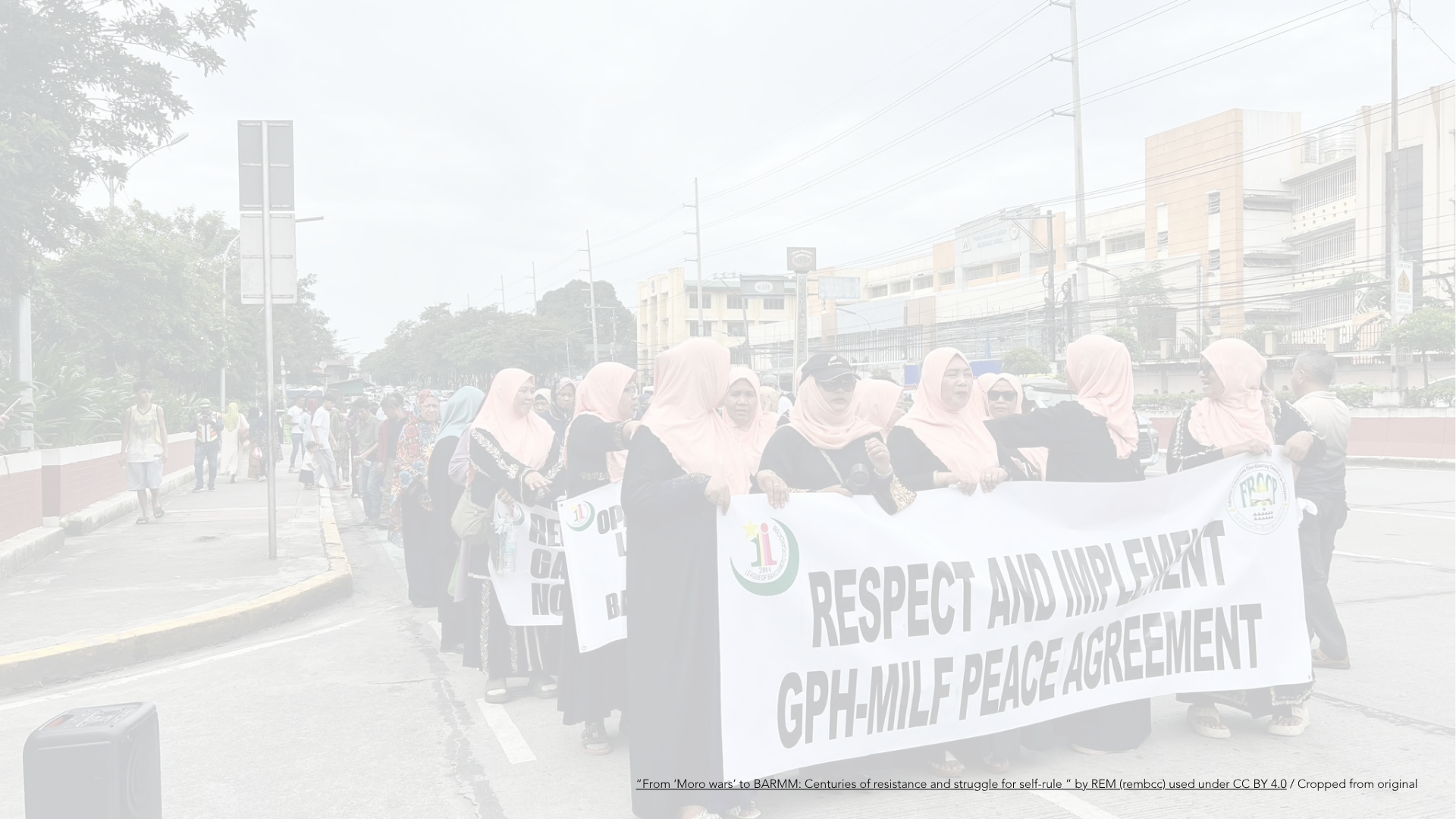
This think piece article forms part of the Bangsamoro Governance and Policy Insights Series released by the Ateneo Bangsamoro Initiative of the School of Government, Ateneo de Manila University. The series is intended to contribute to the ongoing discourse on governance and development in the Bangsamoro region.
When the peace implementing panels of the Government of the Philippines (GPH) and the Moro Islamic Liberation Front (MILF) returned to the table on August 4, they did more than resume a formal meeting. They reopened the bilateral channel through which difficult questions about implementation are supposed to be addressed. MILF Peace Implementing Panel Chair Mohagher Iqbal described the situation succinctly: the agreement continued to bind the parties while “trust, though strained, still holds.” This is probably the most useful way to understand the current state of the Bangsamoro peace process.
The Comprehensive Agreement on the Bangsamoro (CAB) has survived political changes and institutional transitions. More than a decade after its signing, it continues to structure the relationship between the GPH and the MILF and has produced its most significant institutional outcome: the Bangsamoro Autonomous Region in Muslim Mindanao (BARMM). But an agreement can remain intact even when the relationship between the parties becomes more difficult. Recent developments in the Bangsamoro peace process have made this distinction more visible.
In March, the MILF temporarily suspended its bilateral engagement with the national government. The resignation of then-GPH Peace Implementing Panel Chair Cesar Yano, together with leadership changes at the Office of the Presidential Adviser on Peace, Reconciliation and Unity (OPAPRU), including the departure of then-Secretary Carlito Galvez Jr., created uncertainty about who would represent the government in the bilateral implementation process. The problem, therefore, was not simply an interruption in meetings. It raised a more basic question about the continuity of the political relationship supporting implementation of the CAB.
At the same time, the Philippine Government and the MILF did not bring the entire peace architecture to a standstill. While the MILF announced a temporary pause in the bilateral engagement, it was not extended to ceasefire mechanisms through which the MILF and the Armed Forces of the Philippines continued to coordinate. These mechanisms, particularly the Coordinating Committees on the Cessation of Hostilities and Ad Hoc Joint Action Group, built over years of implementation, continued to provide a channel for managing security concerns in Bangsamoro despite strains in the political relationship between the MILF and the national government. The Philippine government likewise maintained that existing peace mechanisms should continue their work, while acknowledging concerns raised by the MILF leadership.
Trust as the Missing Dimension of Implementation
This combination presents a complicated picture. It shows that the peace process is neither simply succeeding nor breaking down. Some parts of the relationship can remain functional while confidence at the political level weakens. Institutions can provide continuity, but they cannot remove the need for political trust, particularly in a process that still has significant commitments to complete.
Former adversaries do not need to agree on every issue to continue working together. Disagreement does not necessarily mean that a peace process has broken down. Parties can dispute how commitments are being implemented, question particular decisions, or experience periods of political tension while continuing to recognize the agreement – and one another – as the legitimate framework and counterparts through which outstanding issues must be addressed.
Iqbal’s description of trust as strained but still holding captures this ambiguity. It also points to something that conventional measures of peace implementation can easily miss. Peace agreement implementation is often assessed through visible milestones: laws passed, institutions established, combatants decommissioned, socioeconomic interventions delivered, mechanisms convened, or elections conducted. These are necessary measures. They tell us whether commitments made on paper are being translated into institutional and material outcomes. But they do not tell us everything about the relationship through which those commitments are implemented.
This matters because many of the remaining questions under the CAB, particularly along the normalization track, require continued cooperation between the parties. Full decommissioning of combatants, socioeconomic support for former combatants, transitional justice, security arrangements, and other outstanding commitments cannot be completed through institutional design alone. They require repeated negotiation over what commitments mean in practice, what should happen next, and whether each party believes that the other is acting faithfully and consistently with what was agreed.
The CAB itself reflects this recognition. Its implementation was designed around shared responsibility and sustained cooperation between the parties, as well as mechanisms that require them to work together over time. When the joint implementing panels were formally launched in 2016, both parties explicitly linked continued implementation of normalization commitments to sustaining trust and confidence. Trust, in this sense, sits alongside institutions rather than outside them.
Institutions can hold during periods of strain
The temporary disruption of formal bilateral engagement did not mean that the institutional relationships built through the years of peace implementation simply disappeared. The continued operation of some security mechanisms during the bilateral pause for instance, is one indication of the institutional depth the process has acquired – something that the condition of the GPH-MILF political relationship alone does not reveal.
However, this should not be overstated as evidence that the political relationship was healthy. Working mechanisms cannot substitute for bilateral engagement between the parties, particularly when questions requiring joint political decisions remain unresolved. Even so, their continued operation is significant. It suggests that years of peace implementation have produced relationships at different levels of the process.
The GPH-MILF relationship is not confined to the two implementing panel chairs or to meetings between the panels. It also involves joint committees, security mechanisms, technical bodies and working groups, national government and Bangsamoro institutions, communities, and people who have worked with their counterparts for years. These relationships do not necessarily move in the same direction or at the same pace, which creates a more complicated picture of institutional resilience.
Political confidence at the leadership level can deteriorate while working relationships elsewhere continue. But the reverse is also true: good working relationships cannot settle questions that require decisions by political principals. For this reason, the continued functioning of institutions should neither be dismissed nor exaggerated. It is evidence that the peace process has developed mechanisms capable of surviving periods of political uncertainty. It is not evidence that the underlying political relationship is necessarily healthy. The two conditions can exist at the same time.
Implementation also shapes trust
Trust is usually understood as something that makes implementation possible. Parties must have enough confidence in one another to sign an agreement and carry out their commitments. But implementation itself can affect that confidence.
The way disagreements are handled tells each side something about the other. Consultation signals that the other party is being treated as a legitimate counterpart. Using agreed bilateral mechanisms demonstrates that disputes can be brought back into the process rather than settled unilaterally. Following through on commitments builds expectations that future commitments will also be taken seriously. The opposite is also true. Repeated delays, decisions perceived as unilateral, or disagreement that remain unresolved can change how one party interprets the actions of the other. This is particularly important as the Bangsamoro peace process moves further into implementation.
During negotiations, trust is openly discussed because former adversaries are deciding whether they can work together as political counterparts. Once institutions are established, there is a tendency to assume that the institutions themselves have reduced the need for that relational work. In practice, they have not. Institutions can reduce dependence on individual relationships by creating rules, procedures, and responsibilities so that cooperation does not depend entirely on who happens to occupy a particular office. But institutions themselves have to be used, interpreted, and respected. An institution cannot by itself create confidence between political actors who believe that the other side is not acting consistently with the spirit of the agreement.
This is why the principles repeatedly emphasized by the parties remain important. Earlier this year, amid strained relations with the MILF, then-OPAPRU Secretary Carlito Galvez Jr. described the spirit of the CAB in terms of “jointness, bilateralism, and mutuality,” reflecting how the political settlement is meant to function. In May, Secretary Mel Senen Sarmiento referred to “parity of esteem grounded in mutual respect” and “joint implementation through sustained adherence to non-unilateral action” in response to the findings of the Third Party Monitoring Team on the progress of the CAB’s implementation.
At the August 4 resumption of the GPH-MILF bilateral meeting, Sarmiento put the issue more directly: “These are not simply technical questions. They are questions of trust”. That is the larger point. The principles of bilateral implementation are not merely procedural rules. They are also ways of maintaining political relationship on which implementation depends.
Looking beyond milestones
For policymakers and peace partners, there are therefore two things to watch:
The first is the implementation record. Outstanding commitments under the CAB remain important, particularly those under the normalization track. Progress should continue to be measured against what the parties agreed to deliver, while recognizing that implementation cannot always be reduced to a list of completed projects or activities. Whether something counts as progress can also depend on whether parties recognize and validate the implementation in the same way.
The second is harder to measure: the condition of the relationship through which the remaining commitments will be completed. There is no need to create a numerical ‘trust index’ nor should every disagreement between the parties be interpreted as evidence of crisis. More useful questions are practical ones. Are the agreed mechanisms being used when disagreements emerge? Are the parties consulting each other before decisions affecting joint commitments are made? Are bilateral meetings taking place regularly enough to prevent unresolved issues from accumulating? Do both sides still regard the existing mechanisms as legitimate avenues for resolving differences? Perhaps the most important question is whether the parties can disagree seriously without abandoning the process through which those disagreements are supposed to be resolved? These questions do not replace conventional measures of implementation. They provide context for what those measures mean.
A peace process can continue to produce institutional milestones while political confidence declines. It can also experience a serious disagreement without losing the accumulated trust and institutional relationship that allow the parties to return to the table. Distinguishing between these conditions matters because the second condition is more recoverable than the first.
What it means to return to the table
The August 4 resumption of bilateral engagement should therefore be viewed neither as proof that the recent difficulties have disappeared nor as just another meeting in a long implementation calendar. Its significance is that the parties have returned to the mechanism through which unresolved issues can be addressed jointly. That is why Iqbal’s description is useful. The agreement still binds the parties. Trust has been strained. But it has not disappeared.
The durability of the peace process will depend partly on whether the remaining trust is enough to sustain difficult conversations about implementation. A peace agreement should be capable of surviving periods of political uncertainty. The fact that some institutions continued functioning during the recent pause suggests that years of implementation have created some resilience. But resilience should not become complacency. The political relationship still matters. Institutional mechanisms can preserve continuity, but they cannot substitute indefinitely for confidence between the parties. If disagreements continue to be brought back into those mechanisms, the institutions can help rebuild trust. If they are bypassed or treated as obstacles, institutional continuity may become much less meaningful.
The return of the GPH and MILF implementing panels to bilateral engagement provides an opportunity, not a resolution. Much will depend on what follows: how outstanding commitments are addressed, whether differences can be negotiated without undermining the relationship, and whether both parties continue to experience implementation as a joint undertaking. In that sense, completing the commitments contained in the CAB is also partly a matter of sustaining the trust that allows the parties to keep implementing them.
Ms. Hyro M. Domado is a Contributor at the Ateneo School of Government Policy Center. The views expressed herein are those of the author and do not necessarily reflect the views of Ateneo de Manila University.