
This think piece article forms part of the Bangsamoro Governance and Policy Insights Series released by the Ateneo Bangsamoro Initiative of the School of Government, Ateneo de Manila University. The series is intended to contribute to the ongoing discourse on governance and development in the Bangsamoro region.
Two game-changing events unfolded within the same week: the Supreme Court’s unprecedented ruling that Congress has a mandatory constitutional duty to enact a law prohibiting political dynasties, and the inaugural parliamentary elections of the Bangsamoro Autonomous Region in Muslim Mindanao’s (BARMM). At first glance, these may appear to be separate developments. They are not. Both go to the same fundamental question: how can political power be made more competitive, accountable, and genuinely representative when political families remain deeply embedded in the system?
On 16 September, the Supreme Court declared in Kapatiran Party vs. Congress of the Philippines (G.R. No. 263934) that Article II, Section 26 of the 1987 Constitution is not merely an aspiration. It imposes a mandatory duty on Congress to enact a law prohibiting political dynasties. The Court held that Congress’ failure to do so for almost 40 years constituted grave abuse of discretion. It further directed Congress to act with utmost urgency, while leaving to lawmakers the task of defining the scope and coverage of the prohibition.
Can Congress overcome its deep conflict of interest?
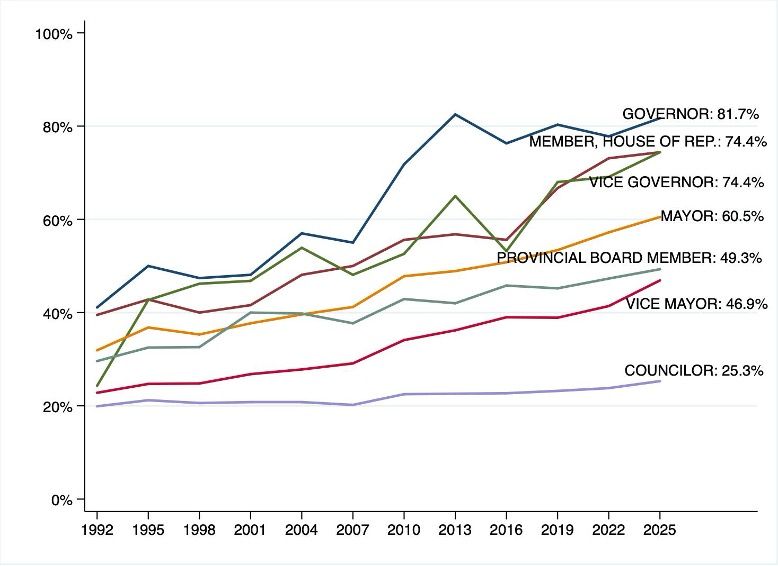
Meanwhile, for almost 40 years, political clans have slowly captured Congress, eroding its inclusivity and democratic legitimacy, and creating deep conflict of interest in terms of changing the status quo of high economic and political inequality where they themselves remain on top of the power pyramid. Recent estimates from the 2025 Philippine midterm elections[1] show that political dynasties have gradually expanded over time, from 22% in 1992 to 32.6% in 2025. This means that around 5,848 out of the almost 12,084 elected positions in 2025 are occupied by politicians with at least one relative in elected office. Why will those who benefit the most from the present lopsided system change it?

Under this environment, the Supreme Court just flexed its independence, and its ruling is important because it settles a fundamental constitutional question. The phrase “as may be defined by law” does not mean Congress has a choice whether to prohibit dynasties. Its discretion lies in determining how they should be defined and regulated, not whether the constitutional command should be implemented.
Yet the decision also exposes the limits of judicial power. The Court can declare Congress constitutionally obligated to legislate, but it cannot write the law itself. Nor can it dictate its precise content. Indeed, the Court expressly recognized that COMELEC cannot disqualify candidates merely because they belong to political families in the absence of legislation defining the prohibition.
This makes the ruling less a mechanism for immediately dismantling dynasties than a constitutional challenge directed at both Congress and the electorate. Congress must now act. But voters ultimately determine whether lawmakers who have benefited from the existing political order will be rewarded or punished for what they do—or fail to do.
There is an important irony here. Congress is hardly unfamiliar with the issue. The House approved an anti-political dynasty bill in June 2026, while the Senate has its own measure pending. The problem, therefore, is no longer simply whether Congress recognizes the constitutional mandate. It is whether it can produce a meaningful and enforceable law despite the political interests represented within Congress itself.
The BARMM election provides the other half of this story.
On 14 September, Bangsamoro voters elected their first regular Parliament, ending seven years of transitional government and moving the region from appointed governance toward a democratically elected parliamentary system. A fundamental promise of the peace agreement, the BARMM elections signalled the openness to a governance innovation that broke from traditional politics, possibly ushering greater inclusion and legitimacy in a region racked with underdevelopment and conflict. More than two million voters participated, producing an 84.34% turnout. The election was far from perfect. Violence occurred, pre-shaded ballots were discovered in Maluso, and both Maluso and Cotabato City were placed under COMELEC control. Yet the election proceeded, and the results were ultimately proclaimed.
The deeper significance is that BARMM demonstrates both the persistence of political clans and the possibility of moving beyond them. Traditional political families remain powerful, but the election also saw the emergence of functioning regional political parties. Thirteen parties competed for the regional parliamentary vote, and no single bloc won a majority, making coalition-building necessary. Nevertheless, similar to the slow elite capture that undermined the pro-reform prospects of the Philippine Congress, it is apparent yet again that traditional politicians seek to capture the BARMM parliament.
Based on our estimates, up to 22.5% of the BARMM parliament or 18 out of 80 seats could be occupied by politicians that are related to one another (Figure 2).[2] These fat dynasties, defined as political families wherein members occupy multiple elected positions simultaneously within the same jurisdiction, can compromise institutional oversight and the allocation of public resources by concentrating decision-making in the particularistic interests of a few families rather than the public good of the entire region. Empirical research by the Ateneo Policy Center has already illustrated the links between political dynasty rule and poverty, corruption risk, terrorism, and election-related violence in the Philippines. In the newly established BARMM parliament, the early dominance of these families could potentially hinder the development of a broad-based and programmatic political party system.
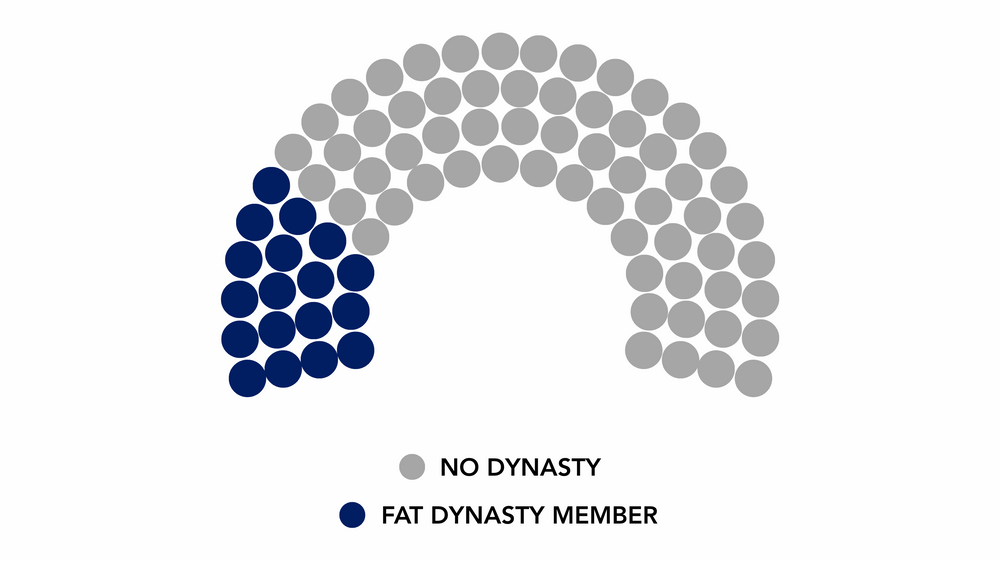
Figure 2. Proportion of BARMM Parliament seats occupied by fat dynasties.
Despite the emphasis on strengthening political parties and sectoral representation in the BARMM elections, there are already signs that political dynasties are still able to extend influence across electoral cycles. Figure 3 below shows the extent of thin dynasties, defined as a political family wherein members occupy positions within a jurisdiction sequentially, in the BARMM Parliament. Approximately 56.25% of the current BARMM parliament (45 out of 80 seats) is occupied by politicians who have relatives that served in the Bangsamoro Transition Authority 3 (March 2025 - September 2026). Thin dynasties also seem to dominate district-level politics more strongly. Figure 4 shows that thin dynasties occupy 42.5% of party representatives (17 out of 40 seats), 12.5% of sectoral representatives (1 out of 8 seats), and 84.38% of district representatives (27 out of 32 seats). If left unchecked, it is likely that BARMM will be captured by the same dynasties that already dominate the conflict prone and highly unequal landscape that plunged that region into violence in the first place.
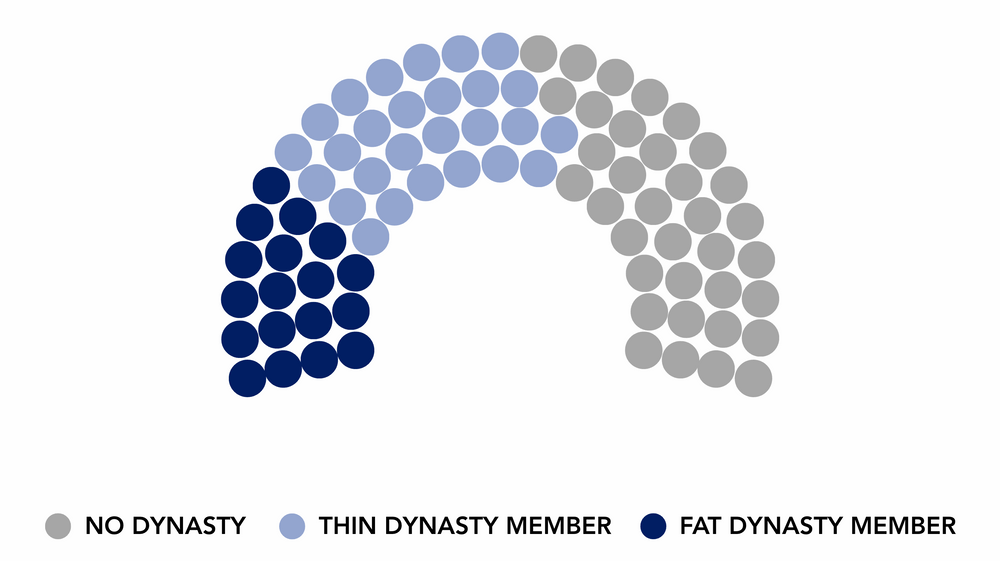
Figure 3. Proportion of BARMM Parliament seats occupied by thin dynasties
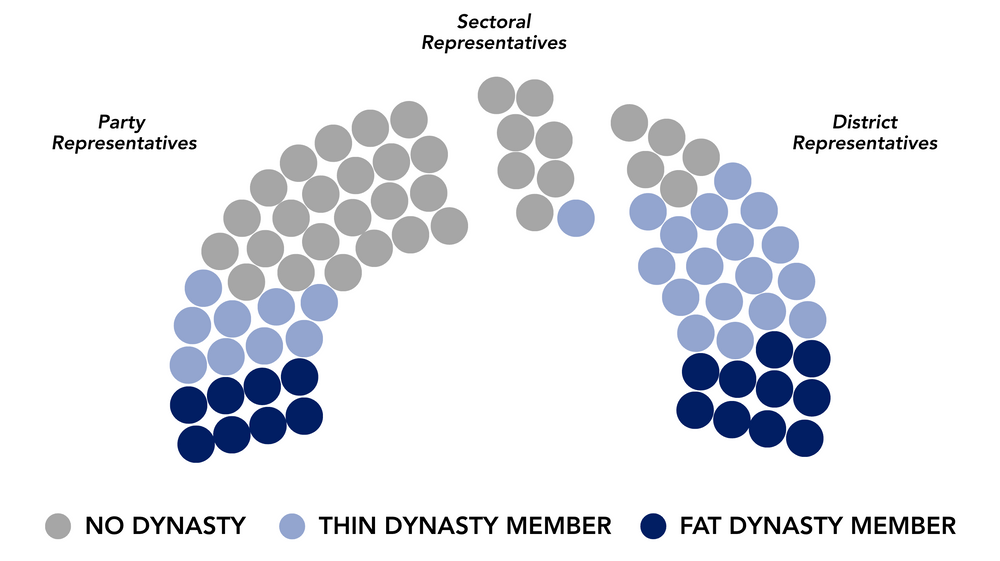
Figure 4. Proportion of BARMM Parliament seats occupied by dynasties by position
That may be the sliver of hope.
Getting rid of political dynasties is only one part of the equation. A democracy also needs political parties capable of organizing citizens around programs, principles and accountability rather than surnames. The BARMM is still at the beginning of that journey, but its new parliamentary system provides institutional space for such parties to develop. Of course, this possibility is further boosted by the existence of regional laws regulating the participation of political dynasties in the parliamentary election. Interestingly, the constitutionality of the power of the BARMM government to regulate political dynasties in the region is currently being litigated in the Supreme Court. It goes without saying that the resolution of this issue must be consistent with the court’s Kapatiran Party decision.
Perhaps this is what connects the two events most clearly. The Supreme Court has reminded Congress of its constitutional duty. The BARMM election reminds the rest of the country that aspirations and advocacies for institutional reforms must eventually be matched by political organization.
Dynasties will not disappear simply because a law is passed. Voters, taxpayers, civil society and political parties must build alternatives. In that sense, BARMM maybe a baby step ahead of the rest of the Philippines—not because it has solved the problem, but because it has begun experimenting with the political machinery needed to move beyond politics dominated by political clans.
Atty. Michael Henry Yusingco, LL.M and Gabrielle Ann S. Mendoza, MA, are affiliated with the Ateneo School of Government Policy Center. The views expressed herein are those of the authors and do not necessarily reflect the views of Ateneo de Manila University.
[1] Data calculated using 97.37% of the 2025 election results.
[2] Using the surname approach, the following clans were identified as fat dynasties: Abas (3), Adiong (3), Balindong (2), Ebrahim (2), Hataman (2), Mangudadatu (2), Midtimbang (2), and Gandamra (2).