
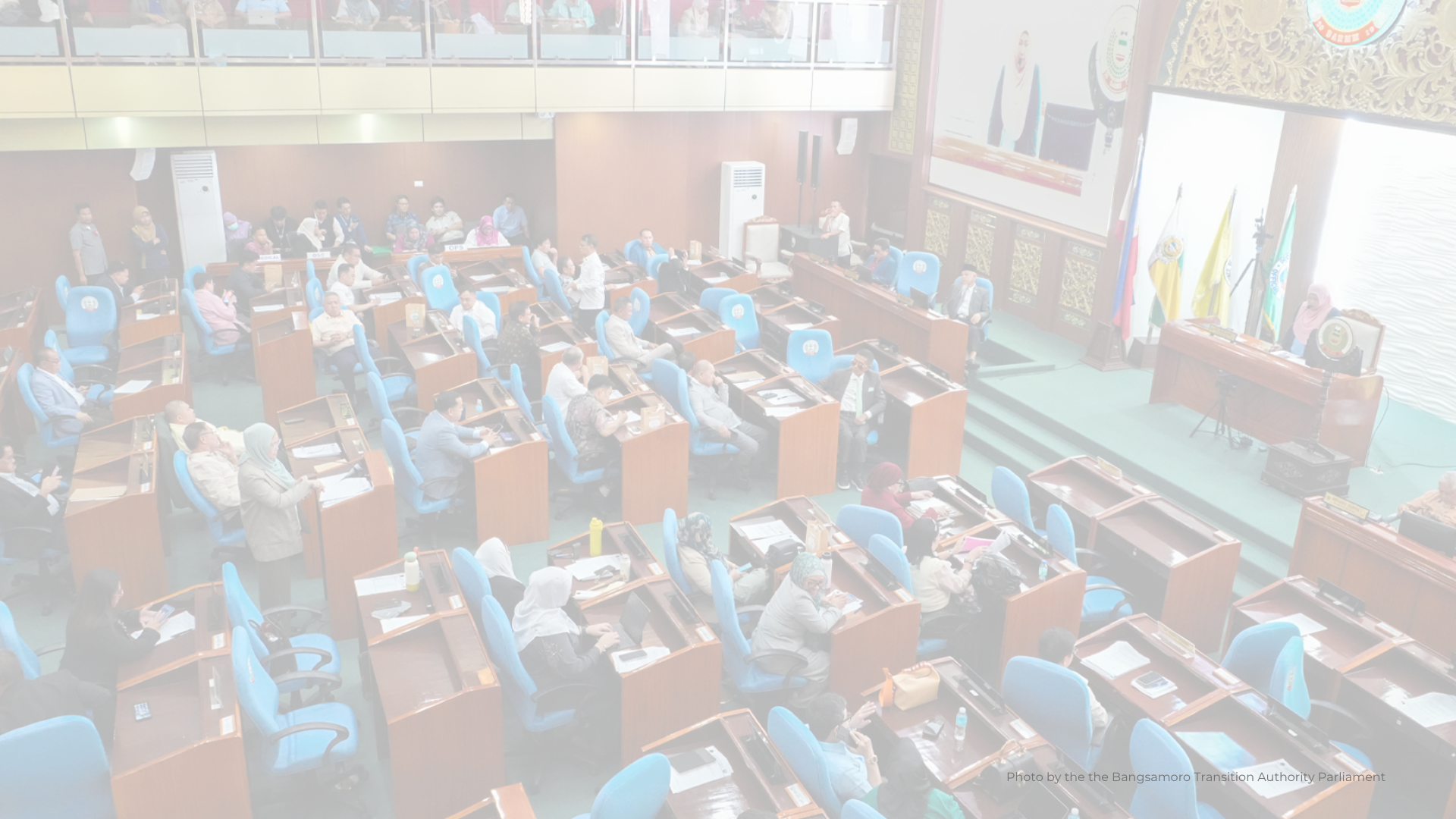
This article forms part of a series of think pieces to be released by the Ateneo Bangsamoro Initiative of the School of Government, Ateneo de Manila University. The series is intended to contribute to the ongoing discourse on governance and development in the Bangsamoro region.
Introduction
The Bangsamoro Autonomous Region in Muslim Mindanao (BARMM) is still preparing for its first parliamentary elections—a historic milestone that could redefine regional governance in the country. It is truly unfortunate that the election has been postponed several times. The latest setback is the ruling by the Supreme Court that the Bangsamoro Parliamentary Redistricting Act of 2025 is unconstitutional. Ironically, the Bangsamoro Transition Authority (BTA) is now under direct order of the Supreme Court to enact the correct redistricting legislation. Regional autonomy is once again yielded.
However, even more alarming is that the Bangsamoro polity losing faith on the revolutionary promise of the parliamentary structure is now a distinct possibility. The ratification of the Bangsamoro Organic Law (BOL) was hailed by many as the arrival of a “new dawn” for the Bangsamoro. And central to this promise is the groundbreaking experiment of a parliamentary form of government for the BARMM. The extended transition period where unelected officials are at the helm is slowly eroding optimism amongst regional stakeholders. This regression must be stopped. Regional political parties, more specifically, must reassert their importance in this uncertain time.
Parliamentary democracy is not simply about structures, electoral cycles, or legislative rules. Its health and sustainability rest on an intangible but decisive factor: the ethos of political parties. Shared values, norms, and guiding principles that shape the behavior of parties and their members beyond the systematic pursuit of power. Pertinently, the BOL calls for the formation of “genuinely principled political parties” (see Section 4 of Article IV). Without a party ethos that is rooted in collective responsibility, mutual respect, and orientation toward the common good, parliaments risk devolving into arenas of personal rivalries, factional disputes, or transactional politics.
So clearly, the BARMM’s history of clan politics, electoral violence, and patronage-based loyalties presents formidable challenges. For the Bangsamoro parliament to function effectively, parties must cultivate an ethos that harmonizes traditional values such as bayanihan, Islamic principles of shura (consultation), and modern parliamentary norms of majority rule and collective discipline. Notably, this is precisely the right moment for regional political parties to demonstrate that they embody the aforementioned ethos. This challenging period is an opportunity for them to manifest the readiness to take on the responsibility of ensuring the Bangsamoro parliament exemplifies genuine and meaningful regional autonomy.
In line with this exhortation, this policy brief discusses further the importance of a democratic political party ethos in sustaining the robustness and vibrancy of a parliamentary structure of government. The points are outlined necessarily in the context of the BARMM, but they are also fundamentally anchored on democratic principles that they may likewise apply to politics and governance at the national level. The objective of this brief is to help the Bangsamoro electorate, particularly the regional political parties, to be more vocal and involved in establishing parliamentary democracy in the BARMM.
Discussion
Defining Political Party Ethos
Political party ethos may be described as a moral compass. It embodies a set of shared convictions about how power should be pursued, how decisions should be made, and what obligations members owe to each other and to the public. This ethos transcends mere platforms or campaign promises; it is the culture that sustains cohesion within parties and legitimacy in the eyes of citizens.
At its core, party ethos entails three interlinked dimensions:
- Commitment to the Common Good – the recognition that power is entrusted not for private enrichment but for advancing societal welfare.
- Respect for Majority Rule – the willingness to accept outcomes that may not align with individual preferences, in deference to democratic decision-making.
- Bayanihan Spirit – a deeply Filipino notion of solidarity and shared burden, where personal ambition is tempered by collective responsibility.
These elements provide the ethical infrastructure that transforms parliaments from chaotic forums into disciplined, deliberative bodies capable of producing stable governance. Regional political parties exhibiting this ethos align with the BOL’s conception of the Bangsamoro’s right to self-governance, which is the freedom “to pursue its political, economic, social, and cultural development” (See Section 2 of Article IV). Moreover, regional political parties must keep in mind that they bear the responsibility to maintain “a democratic political system that allows its people to freely participate in the political processes within its territorial jurisdiction.” (See Section 3 of Article IV)
Unlike presidential systems, parliaments hinge directly on the strength of political parties. Governments rise and fall on the basis of party discipline, coalition agreements, and majority support. Without a shared ethos, members may defect at will, coalitions may collapse overnight, and legislative work may be paralyzed. Ultimately, the capacity of government to serve the public interest is compromised.
A robust political party ethos is crucial because majority rule is the operational backbone of parliament. But it functions only when minorities accept outcomes without resorting to obstruction or violence, and when majorities refrain from abusing their numbers. Party ethos thus ensures that numerical power is exercised with restraint and legitimacy. The absence of such an outlook can also cripple the ability of the government to meet the needs of its constituents.
Moreover, in Westminster-inspired systems, ministers are bound by collective responsibility—a doctrine that requires cabinet members to defend agreed policies even if they privately disagreed during deliberations. This is possible only when parties inculcate a culture of loyalty to collective decisions. Without an ethos steeped in parliamentary values, such responsibility collapses into opportunism. In this scenario, government can be stuck in an impasse that can stall vital public services. Blindness to the bigger picture by parliament members can lead to detrimental consequences for the entire polity.
Of course, a bigger worry for the BARMM is that in societies where clan identities and personal loyalties trump ideology, parliamentary systems are vulnerable to fragmentation. This pathology is actually often evident in national politics. Which is the reason why policy formulation and implementation by the central government continue to be dysfunctional. But a strong party ethos can counteract dynastic domination of politics and governance by binding party members to shared norms. Institutionalizing the party ethos mindset is the only way to mitigate, if not eliminate, the pull of patronage and familial politics.
Decision-Making for the Common Good
A well-functioning parliament requires that decisions be justified not by the calculus of individual gain but by their contribution to the common good. In practice, decision-making for the common good in BARMM means transcending the narrow imperatives of clan dominance. For instance, the allocation of public resources—whether for infrastructure, education, or security—must not be captured by local elites for distribution to their networks. Therefore, parties must develop the ethos that policies are evaluated through the lens of regional welfare.
The notion of the common good is spelled out with more detail and clearly made obligatory on the regional government in Section 3 of Article V, to wit:
“The Bangsamoro Government shall exercise the power expressly granted, those necessarily implied therefrom, as well as powers necessary, appropriate, or incidental for its efficient and effective governance and those which are essential to the promotion of general welfare. Within its territorial jurisdiction, the Bangsamoro Government shall ensure and support, among other things, the preservation and enrichment of culture, promote health and safety, enhance the right of the people to a balanced ecology, encourage and support the development of appropriate and self-reliant scientific and technological capabilities, improve public morals, enhance economic prosperity and social justice, promote full employment among its residents, maintain peace and order, and preserve the comfort and convenience of its inhabitants.”
The challenge lies in operationalizing this ethos. Parties can institutionalize mechanisms of internal debate, consultation with grassroots sectors, and accountability measures to ensure that decisions are not merely imposed by leaders but genuinely reflect deliberation on the common good. Indeed, this internal practice must be incorporated as an integral component of constituency consolidation. Accordingly, the usual ritual of mass gatherings where the only participation of the assembly is to cheer on party leaders as they orate on the stage can no longer be a measure of party solidarity. It is a celebratory event, and that is all. Parliamentary democratic values must be evident in the political parties themselves.
Majority Rule and the Discipline of Acceptance
One of the hardest lessons in democratic politics is learning to lose. For parliaments to function, members must accept that majority rule is the final arbiter of collective decisions. This requires political maturity and a culture of restraint—qualities often absent in fragile democracies where electoral defeat is equated with humiliation or political extinction.
In the Bangsamoro context, the tradition of clan politics exacerbates the difficulty of accepting minority status. Leaders accustomed to dominance may view parliamentary losses as existential threats. Here again, party ethos is indispensable: it trains members to internalize the discipline of acceptance. Within parties, once debates are settled by majority vote, dissenters must align with the collective stance. Extending outward, when the parliament passes a law or elects a chief minister, losers must accept the outcome without resorting to destabilization.
The fate of the Bangsamoro Parliamentary Redistricting Act of 2025 is a good illustration of how this ethos can work beneficially for the region. Obviously, the primary consideration at the moment is for the first parliamentary election to proceed as scheduled. With this in mind, the law could have been allowed to be implemented instead of being questioned in the Supreme Court. The first elected Bangsamoro parliament can then enact a new law addressing its flaws. In this scenario, the autonomy of the BARMM is further solidified because its duly elected leaders resolved an internal matter. But by petitioning the Supreme Court, regional leaders acknowledged that internal divisions are still hard to overcome. Which truly does not bode well for the entrenchment of parliamentary democracy in the BARMM.
It is important to emphasize, however, that majority rule must be balanced by respect for minority voices. An ethos of fairness demands that majorities allow space for dissent, ensure transparency, and guard against tyranny of numbers. Domination must never be part of political calculations. Consensus and cooperation must always be the motivating considerations in party and parliament operations. The delicate balance between majority rule and minority recognition is possible only within a culture where rules are seen as binding and outcomes as legitimate.
Bayanihan as the Cultural Root of Party Ethos
The bayanihan spirit is usually depicted by the act of a community carrying a house together, literally lifting it on their shoulders to move it to a new place. Metaphorically, it symbolizes cooperation, sacrifice, and solidarity. While often evoked in national rhetoric, bayanihan takes on sharper relevance in parliamentary contexts.
Parliaments require members to subordinate personal or familial interests to the collective agenda of the party. In BARMM, where politics has historically been driven by clans and kinship ties, bayanihan could provide the cultural anchor for nurturing a sense of shared parliamentary project. Just as villagers set aside individual gain to lift the house, party members must put aside narrow ambition to lift the region toward stability and prosperity.
Bayanihan also resonates with the Islamic value of ummah—the community of believers bound by mutual obligation. When embedded into party ethos, bayanihan could help frame politics not as a contest of rivals but as a shared endeavour for the Bangsamoro’s future. It is mostly treated like a cliché these days, but community solidarity is still a vital and foundational element of a fully functioning democracy, most especially a parliamentary democracy.
Risks of Weak Ethos
The absence of a strong political party ethos carries significant risks. Without it, BARMM’s parliament could succumb to:
- Factionalism and Gridlock – Endless disputes among clans and personalities could paralyze legislation.
- Patronage Politics – Parties may degenerate into distribution networks for resources, eroding legitimacy.
- Instability of Government – Weak party cohesion could lead to frequent collapses of government, undermining confidence in parliamentary rule.
- Erosion of Public Trust – Citizens may perceive parliament as another failed experiment, fueling cynicism and potential unrest.
These risks underline the urgency of building a strong parliamentary ethos even before the first parliamentary election. Obviously, the Bangsamoro electorate is already deeply concerned about the postponements and may leave many voters in the region feeling confused and helpless. In this current state, the Bangsamoro community may see these risks as inevitable. That the BARMM will likely spiral down to becoming another “failed experiment”. In this regard, the regional political parties can stem the downward trend. And if they do not manifest the parliamentary democratic ethos now, then the long-held aspiration of Bangsamoro self-determination will continue to be out of reach.
Conclusion
The notion of a political party ethos is often overlooked in discussions of parliamentary design, yet it is the very foundation on which effective governance rests. For the BARMM, the coming parliamentary election is not just about who wins seats but about whether parties will embody an ethos of bayanihan, decision-making for the common good, and respect for majority rule. These values must temper the region’s legacy of clan politics and violence, offering instead a vision of politics as shared responsibility.
The long-term success of BARMM’s autonomy experiment hinges less on legal texts and more on cultural transformation within political parties. If parties can internalize and practice this ethos, the parliament will not only function but flourish, becoming a model of democratic resilience in the Philippines. If not, the region risks reverting to the old cycle of mistrust and conflict. The choice, ultimately, lies in whether Bangsamoro leaders and citizens alike can lift the house of democracy together, in the spirit of bayanihan.
Atty. Michael Henry Yusingco, LLM is a Senior Research Fellow of the Ateneo Policy Center of the Ateneo School of Government. The views expressed herein are those of the authors and do not necessarily reflect the views of Ateneo de Manila University.